FAQs
What is solid waste?
Municipal solid waste means (a) refuse that originates from residential, commercial, institutional, demolition, land clearing or construction sources, or (b) refuse specified by a director to be included in a waste management plan.
Why do we need to update our SWMP?
The current SWMP was approved in 2005 and needs to be updated to set the legal framework for how waste, recycling and waste reduction/diversion is managed, to evaluate how our current systems are working, and to recommend areas for improvement, including how we can move towards zero waste.
How does the Environmental Management Act (EMA) relate to this project and what requirements must be followed in updating the SWMP?
The Environmental Management Act mandates regional districts to develop plans for the management of municipal solid waste and recyclable materials. Solid waste management planning and implementation is governed by the Environmental Management Act (EMA - Part 3, Sections 23-38). The EMA requires a regional district to develop a solid waste management plan for approval by the minister. The minister:
• Must be satisfied that there has been adequate public review and consultation during the development of the solid waste management plan before approving the plan
• May approve all or part of a waste management plan, or an amendment to an existing plan
• May set conditions for approval, may choose not to approve the plan, or may order that an existing plan be cancelled or amended
What will the updated SWMP cover? What will guide the update?
The eight provincial guiding principles help to scope the development of solid waste management plans.
1. Promote zero waste* approaches and support a circular economy*
Encourage a shift in thinking from waste as a residual requiring disposal, to waste as a resource that can be utilized in closed-loop systems. Zero waste approaches aim to minimize waste generation and enable the sustainable use and reuse of products and materials. At the local level, look to remove barriers or encourage opportunities that will contribute to towards the establishment of a circular economy.
2. Promote the first 3 Rs (Reduce, Reuse and Recycle)
Elevate the importance of waste prevention by prioritizing programming and provision of services for the first 3 Rs in the 5 R pollution prevention hierarchy.* Implement programs and services that consider provincial and regional targets for waste reduction and environmental protection. Encourage investments in technology and infrastructure and ensure they occur as high up on the hierarchy as possible.
3. Maximize beneficial use of waste materials and manage residuals appropriately
Technology, best practices and infrastructure investments should continue to develop to recover any remaining materials and energy from the waste stream, and to manage residuals for disposal.
4. Support polluter and user-pay approaches and manage incentives to maximize behaviour outcomes
Producer and user responsibility for the management of products can be supported through the provision of market-based incentives, disposal restrictions on industry-stewarded products, zoning to support collection facilities, and support for reuse and remanufacturing businesses. Education and behaviour change strategies aimed at consumers and businesses will help foster further waste reduction, reuse and recycling. For example, user fees can be managed as incentives to increase waste reduction and diversion.
5. Prevent organics and recyclables from going into the garbage wherever practical
Maintaining a system to prevent organics and recyclables from going into the garbage will provide clean feedstock of greater economic value as well as a potential end product use to the recycling industry, while reinforcing behaviour to reduce, reuse and recycle. Innovation in separation solutions, establishment and enforcement of disposal restrictions or other creative means will influence this approach.
6. Collaborate with other regional districts wherever practical
Collaboration on many aspects of solid waste management (e.g., to access facilities and markets, share campaigns and programs) will support the most efficient and effective overall municipal solid waste system.
7. Develop collaborative partnerships with interested parties to achieve regional targets set in plans
Strengthen partnerships with interested parties to achieve regional targets. All waste and recycling sector service providers, associations, and environmental organizations, product stewardship producers and agencies, and waste generators are key interested parties in achieving these targets. Cooperative efforts will optimize successful outcomes. Encourage a marketplace that will complement stewardship programs and drive private sector innovation and investment towards achievement of targets.
8. Level the playing field within regions for private and public solid waste management facilities
Solid waste management facilities within a given region should be subject to similar requirements. A consistent set of criteria14 should be used to evaluate the waste management solutions proposed by private sector and by a regional district or municipality.
* For more about these terms/concepts, see the next FAQ item.
What is zero waste, a circular economy, and the pollution prevention hierarchy?
In alignment with the provincial Guide to Solid Waste Management Planning, the RDKB’s SWMP update will be guided by the approaches and hierarchy that are explained below.
Zero waste is “the conservation of all resources by means of responsible production, consumption, reuse, and recovery of products, packaging, and materials without burning and with no discharges to land, water, or air that threaten the environment or human health,” according to the Zero Waste International Alliance.
Environment Canada defines a circular economy this way: Nothing is wasted. A circular economy retains and recovers as much value as possible from resources by reusing, repairing, refurbishing, re-manufacturing, repurposing, or recycling products and materials. It’s about using valuable resources wisely, thinking about waste as a resource instead of a cost, and finding innovative ways to better the environment and the economy. Visit Environment Canada’s circular economy page for more information and a few videos.
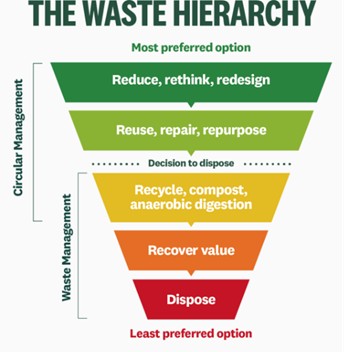
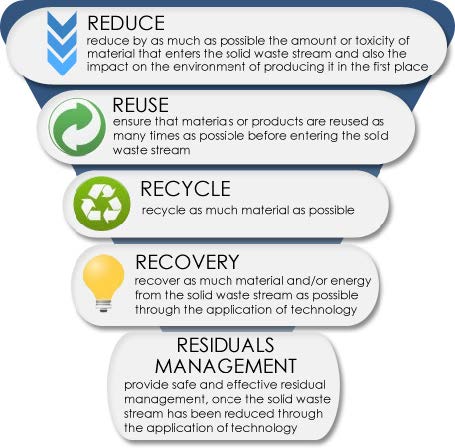
The 5 R pollution prevention hierarchy is a useful planning tool for moving towards zero waste and it supports a circular economy approach. Once all achievable opportunities at a higher level have been taken, only then should the next level be looked at. For example, opportunities for recycling should be explored only after all opportunities for reduction and reuse of materials have been exhausted.
What are other Regional Districts doing?
While population densities, waste management infrastructure, and potential for new investment in waste systems varies across Regional Districts throughout BC, many updated SWMPs focus on common leading practices. These often include:
• Updates to operational lifespans of existing facilities (e.g., timelines for a landfill to reach capacity).
• Opportunities to optimize, and where possible add to, regional infrastructure availability, especially relating to diversion of organic or recyclable materials.
• Strategies to reduce waste and support reuse, especially in relation to waste streams that are increasing (e.g., construction waste) or have embedded impacts (e.g., organic waste that ends up in landfill creates higher GHG emissions than when composted).
• Desired diversion goals, programs and approaches for specific target audiences (i.e., residents, multi-family properties, and industrial, commercial and institutional). Example: The Capital Regional District is developing a series of waste reduction guidelines and tools for sectors including property managers, developers, food and beverage, construction and demolition, and general retail businesses.
• Identification of behavior change, education and enforcement strategies. Example: Metro Vancouver has developed an extensive set of educational resources and tool-kits on waste sorting and diversion, specific to different sectors and audiences. Taking a regional approach to signage, education and resource development has led to improved diversion outcomes in member municipalities.
• Enhancements of policies and practices to drive continual improvement in waste management throughout the region.
What are current waste management practices in the region and where can I get more information?
For frequently asked questions about current waste management in the region (e.g., curbside collection, organics, garbage, and recycling click here.