🔥 FireSmart in the Kootenay Boundary: Let’s Open the Toolbox (We’re Back!) 🔥
Thanks for your patience, Greenwood—we had to postpone in February, but we’re back and ready to go!
Wildfire resiliency isn’t one-size-fits-all — it takes the right tools, used in the right places.
Join the RDKB FireSmart & Emergency Management team, Cabin Resource Management, and CR Professional for a relaxed, informative conversation about wildfire risk reduction and fuel management in your area.
📍 City of Greenwood
🗓 Wednesday, April 29
🕕 6:00 PM
📌 McArthur Centre, 1355 Veterans' Lane
🌲 Learn how landscape-level planning, fuel treatments (including prescribed fire), and FireSmart actions around your home all work together to build stronger, safer communities.
Let’s build wildfire resiliency—together. 💪🔥
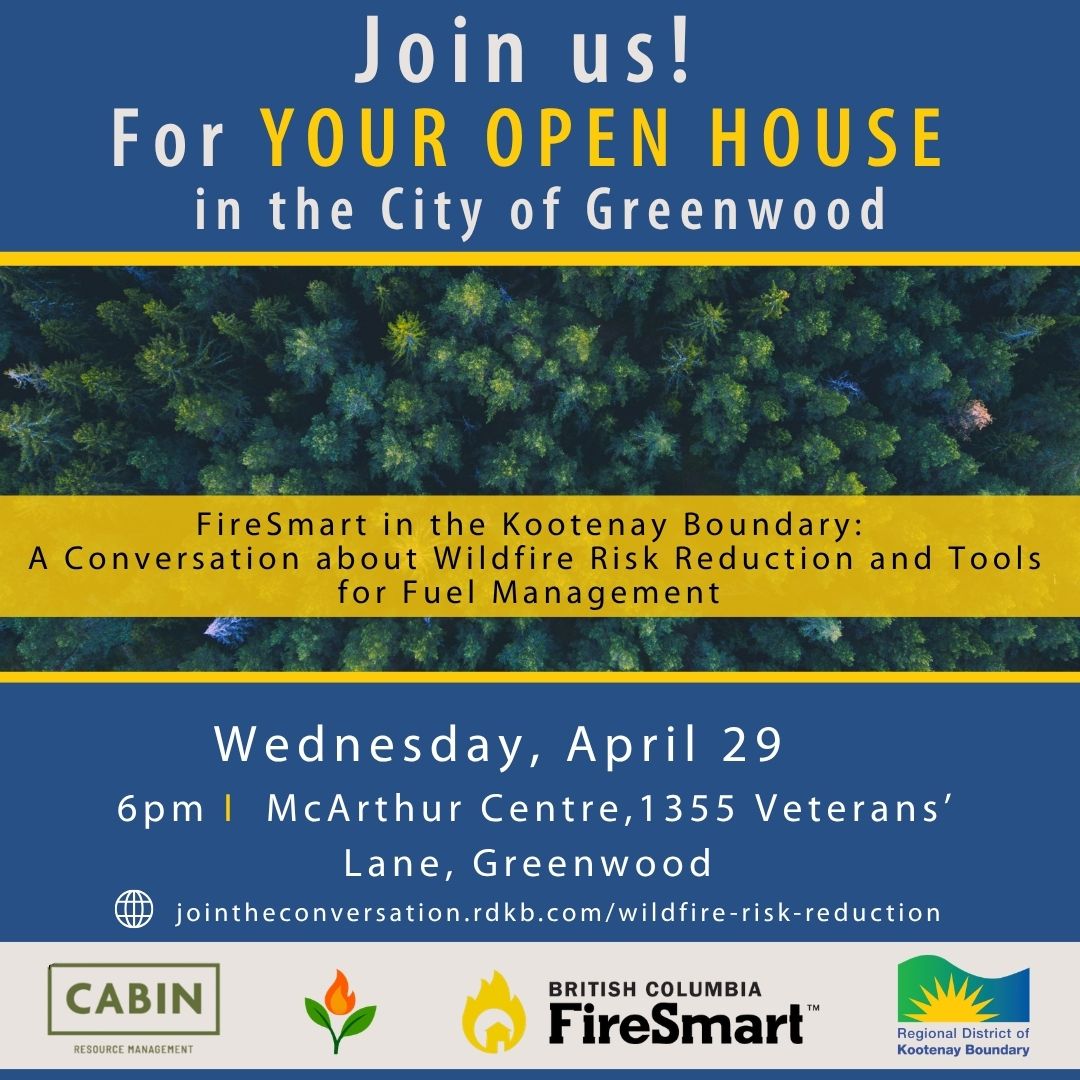
FireSmart in the Kootenay Boundary: A Conversation about Wildfire Risk Reduction and Tools for Fuel Management
When it comes to wildfire resiliency, there isn’t just one solution. There’s a whole toolbox.
The RDKB FireSmart & Emergency Management team, alongside Cabin Resource Management and CR Professional, invite you to join us for a series of open houses focused on wildfire risk reduction in our region — and the tools available to help protect our communities and ecosystems in the Wildland Urban Interface (WUI).
Across the RDKB, Fuel Management Prescriptions are being developed at a landscape level. These plans:
✔ Assess recommended treatment areas identified in our Community Wildfire Resiliency Plans
✔ What vegetation will be treated, and how to reduce wildfire risk around communities.
✔ Are developed by Qualified Forest Professionals
✔ Are verified by BC Wildfire Service
✔ Lead to site-specific vegetation (fuels) management
✔ Help determine the right tool for the job
And yes — Prescribed Fire is one of those tools.
So are thinning, pruning, fuel-free zones, and in-community FireSmart actions.
Just like any toolbox, each tool has a purpose. Used together — strategically and collaboratively — they strengthen wildfire resiliency, support ecosystem restoration, and help protect homes and infrastructure.
These plans are not created in isolation. They are developed and implemented collaboratively across:
🤝 RDKB 🤝 First Nations 🤝 Municipal partners & fire departments 🤝 BC Wildfire Service 🤝 Local professionals and community groups
And while landscape-level planning is critical, so is in-community FireSmart action. What you do on your property matters.
We’ll walk through the plans, explain the tools, and open the floor for conversation.
Additional Open House Dates (The series has now been completed):
📍 March 10 – Village of Montrose, 6:00 pm, Montrose Community Hall (490 9th Ave)
📍 March 11 – Village of Warfield, 6:00 pm, Warfield Community Hall (900 Shutek Dr)
📍 March 12 – City of Trail, 6:00 pm, JL Crowe Secondary School (1300 Frances Moran Rd)
Wildfire resiliency takes planning. It takes partnership. And it takes the right tools. Let’s open the toolbox — together. 🔥
BACKGROUND INFORMATION
Wildfire Risk Reduction - Forest Fuel Management Prescriptions and Treatments in the RDKB
This project involves developing and implementing fuel management prescriptions for wildfire risk reduction fuel management treatments to occur on on approximately 154 hectares in and around the communities of Greenwood (94 ha), Trail (50.5 ha), Warfield (1 ha) and Montrose (8.1 ha)- See maps in the documents section.
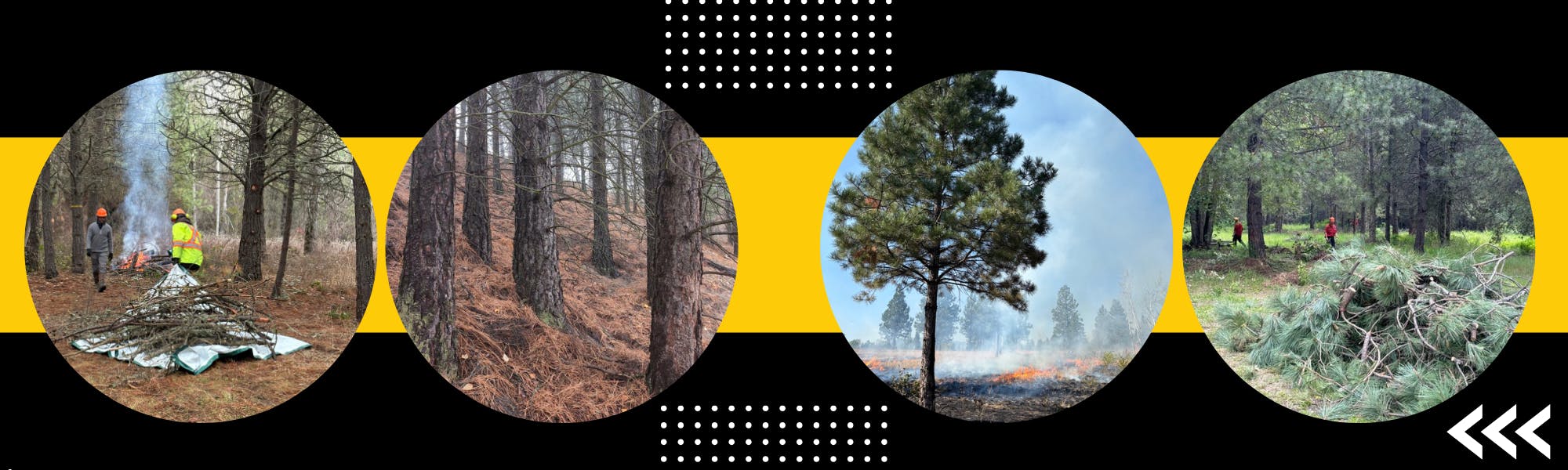
Fuel management treatments will include hand treatments (such as pruning tree branches to increase the distance from the ground and live crown, reducing or removing forest floor fines and small fuels, burning small piles as a tool for debris management, and/or applying controlled prescribed fire to the landscape). Any operational treatment implementation, including completing required burning, will take place only when conditions permit.
The treatments will result in:
• Increased public safety in and around the prescribed treatment units by reducing the wildfire risk in the wildland urban interface (e.g. – a community surrounded by forest) through vegetation management;
• The creation of more readily defensible spaces that are safe for fire fighters to access and support effective fire suppression efforts;
• Apply fuel modification treatments that mimic historical forest conditions including the reintroduction of wildfire on the landscape through cultural or prescribed fire;
• Where possible, the enhancement of the many values of the treatment area including visual quality, water quality, forest health, wildlife diversity and habitat, air quality, terrain stability, and recreational values.
No planning or fuel mitigation works will occur on private land.
In-person engagement events are likely to take place in February 2026. Specific dates will be confirmed shortly.
If you have any questions, comments, or concerns about this project, please reach out directly to Carlene Pires, Regional FireSmart Coordinator for the Regional District of Kootenay Boundary via email: epc@rdkb.com or telephone: 250-231-1277
Building education and capacity for the RDKB to implement fuel management projects.
At the end of November 2025, the Regional District of Kootenay Boundary (RDKB) and Kootenay Boundary Regional Fire Rescue (KBRFR) hosted S-390 Intermediate Fire Behaviour and S-219 Firing Operations for prescribed fire courses in Warfield led by Colleen Ross, CR Professional, Fire Ecologist, and Certified Burn Boss, and co-hosted with Tristian Hansen, BC Wildfire Service’s Cultural and Prescribed Fire program. These courses had participants from over 12 organizations and agencies across the province, including First Nations partners, municipal fire departments, BC Wildfire Service, Regional FireSmart programs, consultants working in wildfire risk reduction, and land managers.
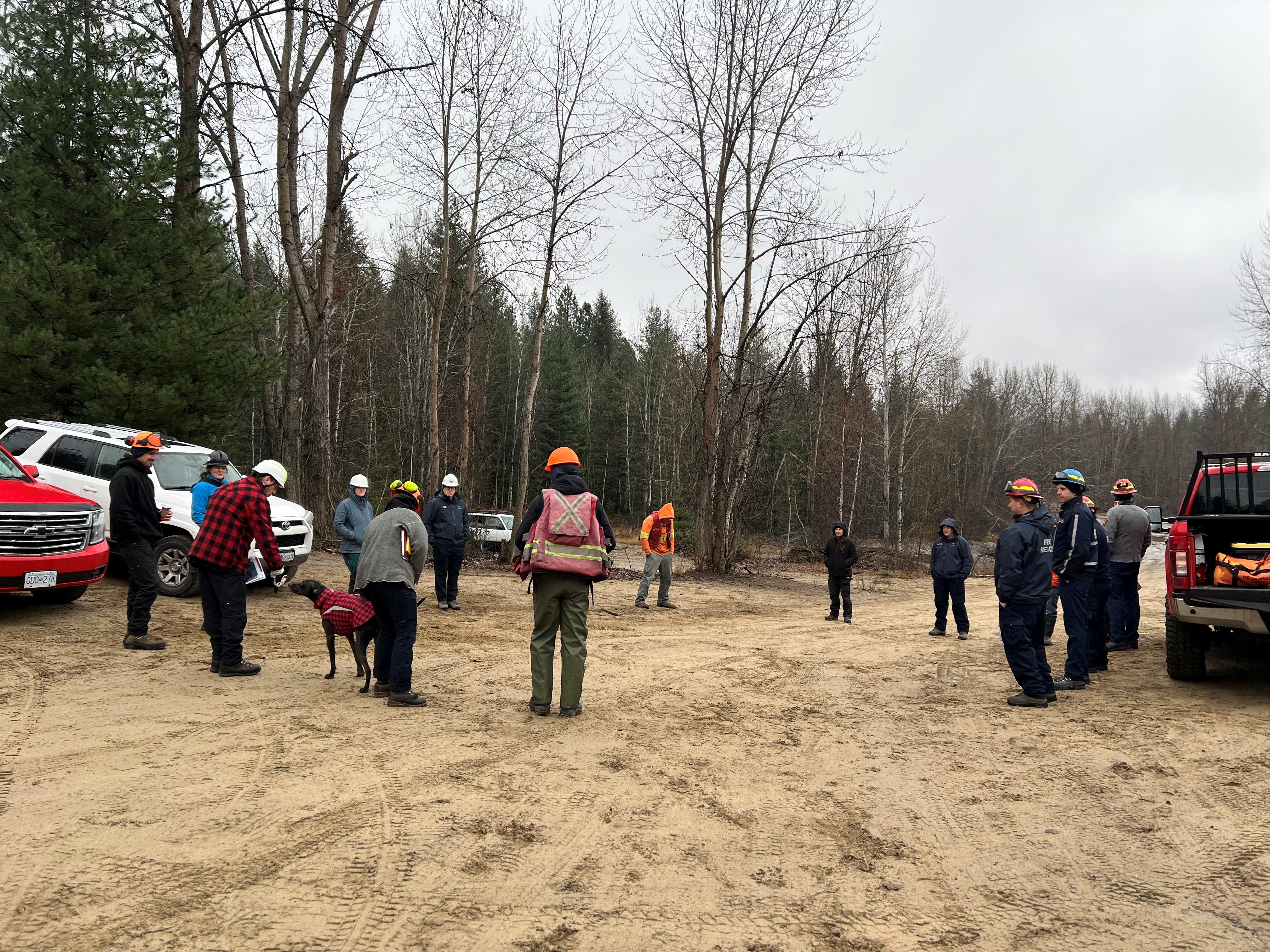 S-219 Burn Plan Field Recce
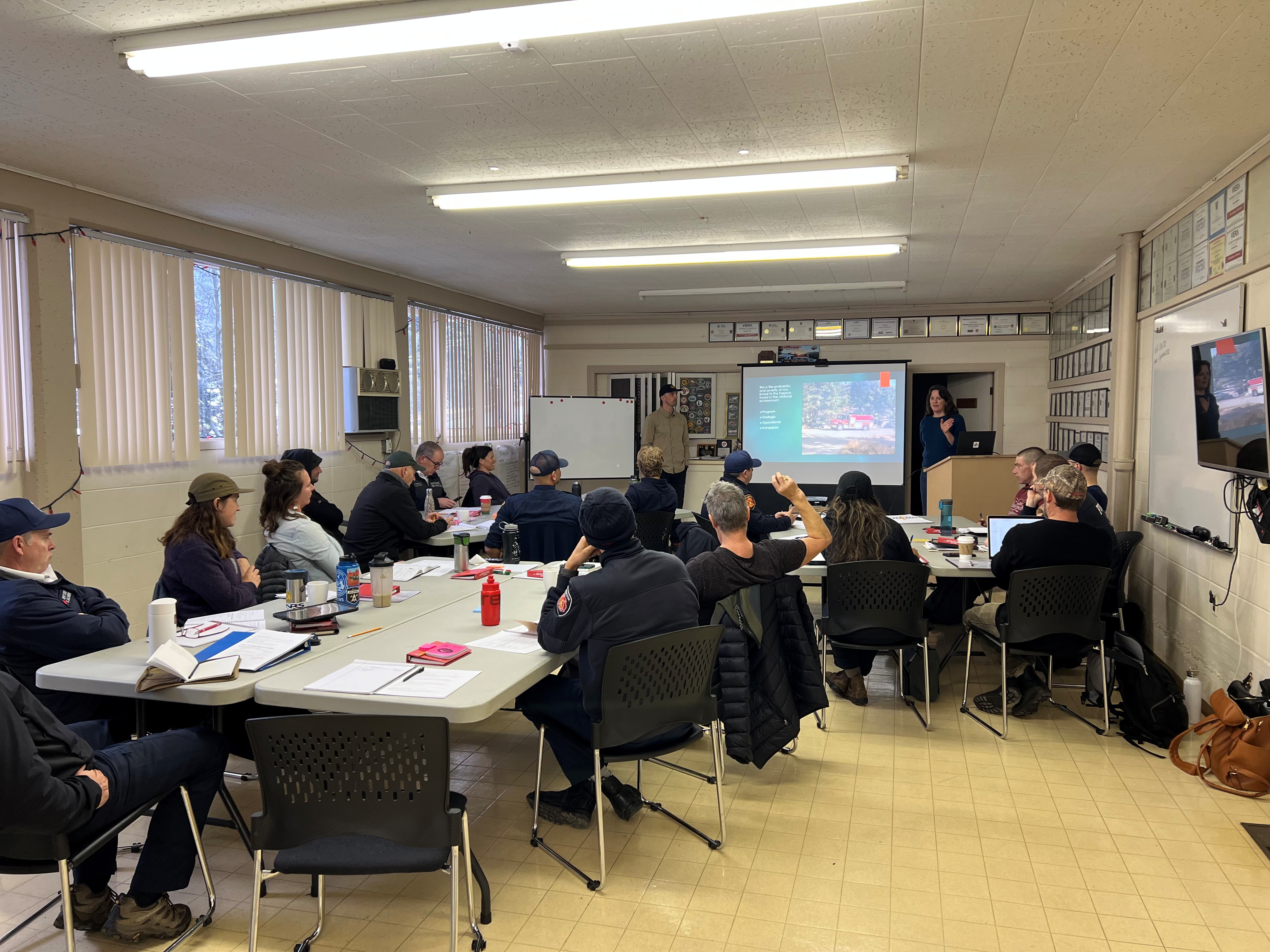 S-219 Classroom Training
S-390 Intermediate Fire Behaviour Training:Our Emergency services providers from KBRFR and RDKB FireSmart completed an applied fire behaviour course built for real‑world operations. We trained on how fuels, weather, and topography interact, and how to use Canada’s Fire Behaviour Prediction System to forecast key outputs and document decisions.
Why it matters: Stronger Wildland Urban Interface (WUI) fuel management prescriptions, safer prescribed burn planning, clearer communication during wildfire response, and treatments that perform as intended. This is a practical step toward reducing wildfire risk to homes, infrastructure, and first responders across our region.
S-219 Firing Operations Training:
Adapted to B.C. conditions and our operational needs, we learned how to plan and carry out safe ignition operations—techniques, tools, coordination, and risk management—through classroom work and a field scenario.
Why it matters for the WUI: better-designed ignition plans support effective fuel management prescriptions and prescribed burns, improving control, safety, and outcomes around homes and infrastructure.
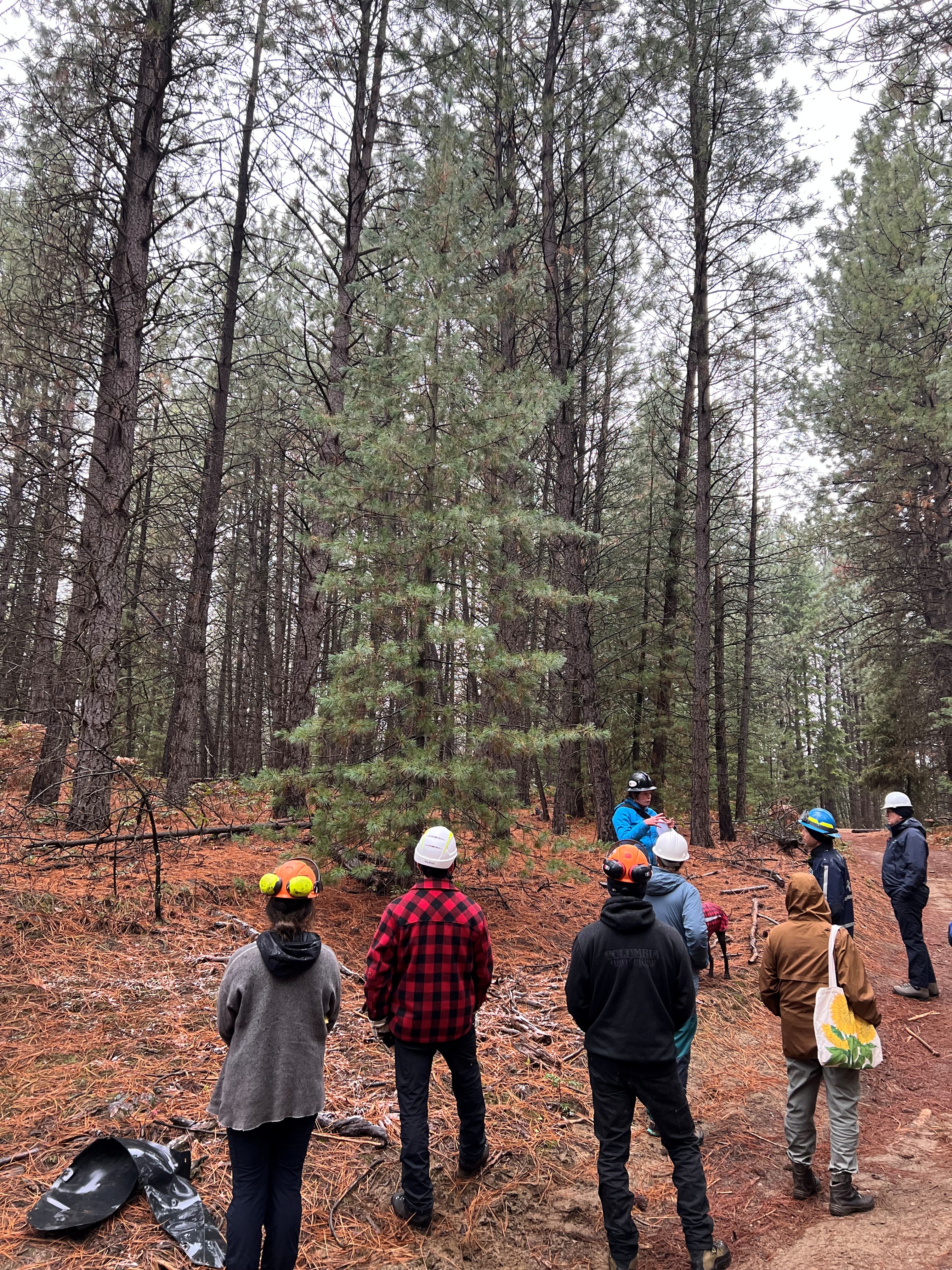 Fire Ecology Discussion
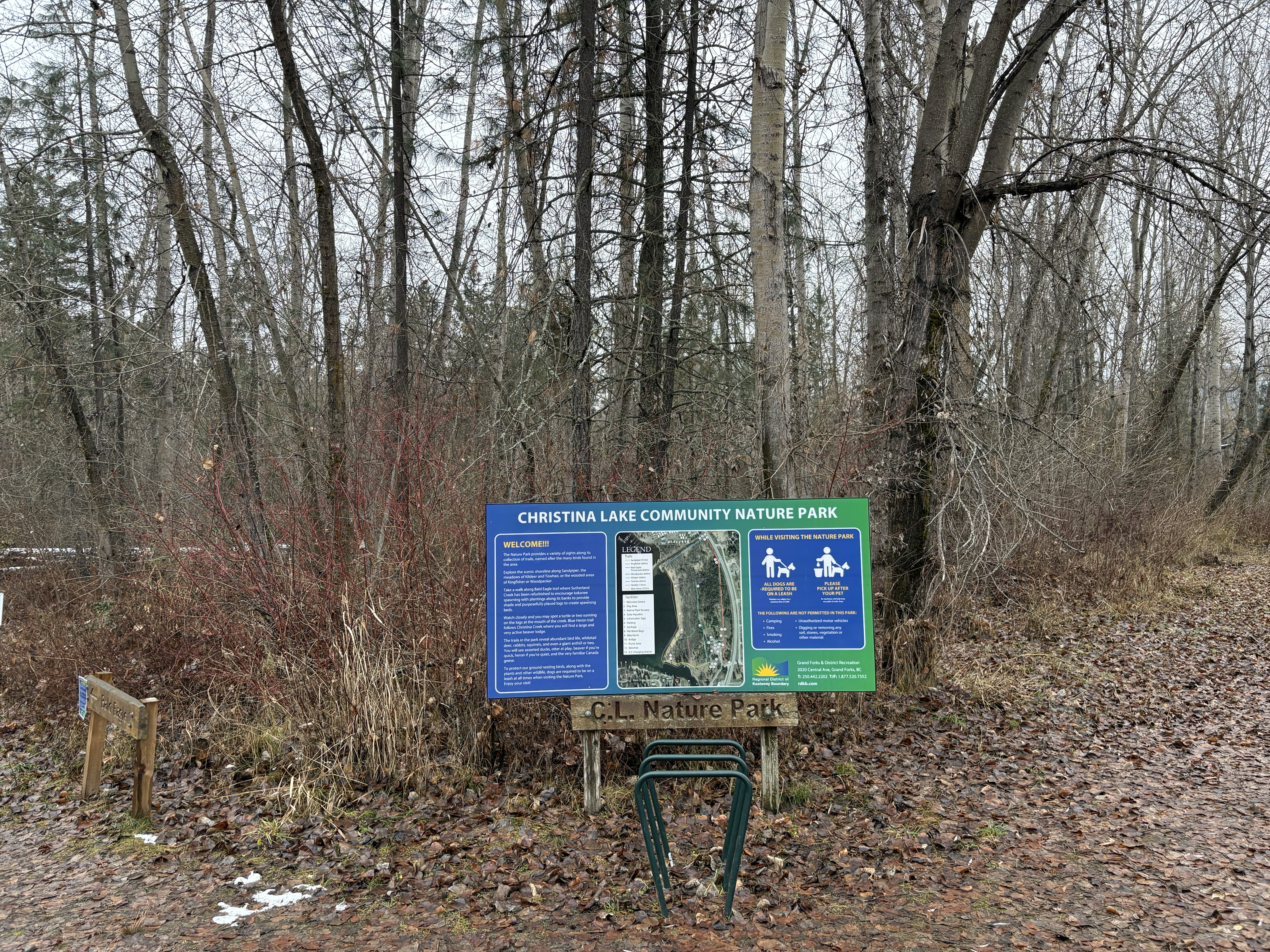
Fuel Mitigation Work at Christina Lake
In partnership with the Christina Lake Stewardship Society (CLSS), the Christina Lake Fire Department, and BC Wildfire Service, the RDKB continues to advance a multi-phase fuel mitigation and prescribed burn project in the Christina Lake Community Nature Park—part of a broader, proactive effort to safeguard the community from escalating wildfire risks.
Launched in fall 2024, the project focuses on reducing forest fuel loads in the park to create a defensible space for firefighters and slow the spread of wildfires before they reach nearby homes. Once complete, the treated areas will function as natural “organic brake pedals,” helping to protect both people and property in the event of a wildfire.
Work at the Community Nature Park will continue into spring 2026 with crews removing ladder fuels, pruning trees, and reducing surface fuels to make the area more resilient to wildfire. A low-intensity prescribed burn of the park’s eastern half is anticipated for fall 2026, pending ideal weather and fuel moisture conditions.
All prescribed burns will follow BC Wildfire Service prescribed fire burn plan templates and include detailed contingency measures to ensure public safety. Similar projects, such as the 2023 Cranbrook Airport burn, have demonstrated how strategic, low-intensity fires can significantly reduce wildfire severity—helping save both lives and property.
“Preparedness starts before the flames,” said Tom Service, Christina Lake Fire Chief. “By reducing fuel and strengthening our community’s fire resilience, we’re setting firefighters up for success. It’s a proactive investment in safety for everyone who lives, works, and visits here.”
Paul Keys, RDKB's Manager of Facilities and Recreation, added that prescribed fire is an essential tool in the modern wildfire management toolkit: “There's a culture shift which views fire as part of the natural cycle of a healthy forest. When used carefully, it restores ecological balance and helps prevent larger, more destructive fires in the future.”
Building a Culture of Fire Stewardship
Projects like this one—and recent work conducted by the Ministry of Forests Wildfire Risk Reduction Program on Swanson Road—are part of an evolving approach to wildfire management in Christina Lake and across B.C. Rather than viewing all fire as destructive, experts now emphasize its ecological benefits when managed under the right conditions.
As the region adapts to hotter, drier summers, regular maintenance and prescribed fire will likely become ongoing, seasonal practices that support both forest health and community safety.
Stay Informed, Stay Connected
RDKB Residents are strongly encouraged to register online for the RDKB’s Voyent Alert system RDKB Emergency Operations Centre (EOC) home page to ensure they can be reached quickly in the event of an emergency.
Sign up for a Free RDKB FireSmart Home Assessment and check out the rebates you can get (up to $5,000) to help make your home and community safer in the event of a wildfire: RDKB FireSmart
To learn more about the science and environmental benefits of controlled burns, residents can visit the BC Wildfire Cultural and Prescribed Fire website
And this research article from Stanford University’s Woods Institute for the Environment
🔥 FireSmart in the Kootenay Boundary: Let’s Open the Toolbox (We’re Back!) 🔥
Thanks for your patience, Greenwood—we had to postpone in February, but we’re back and ready to go!
Wildfire resiliency isn’t one-size-fits-all — it takes the right tools, used in the right places.
Join the RDKB FireSmart & Emergency Management team, Cabin Resource Management, and CR Professional for a relaxed, informative conversation about wildfire risk reduction and fuel management in your area.
📍 City of Greenwood
🗓 Wednesday, April 29
🕕 6:00 PM
📌 McArthur Centre, 1355 Veterans' Lane
🌲 Learn how landscape-level planning, fuel treatments (including prescribed fire), and FireSmart actions around your home all work together to build stronger, safer communities.
Let’s build wildfire resiliency—together. 💪🔥
FireSmart in the Kootenay Boundary: A Conversation about Wildfire Risk Reduction and Tools for Fuel Management
When it comes to wildfire resiliency, there isn’t just one solution. There’s a whole toolbox.
The RDKB FireSmart & Emergency Management team, alongside Cabin Resource Management and CR Professional, invite you to join us for a series of open houses focused on wildfire risk reduction in our region — and the tools available to help protect our communities and ecosystems in the Wildland Urban Interface (WUI).
Across the RDKB, Fuel Management Prescriptions are being developed at a landscape level. These plans:
✔ Assess recommended treatment areas identified in our Community Wildfire Resiliency Plans
✔ What vegetation will be treated, and how to reduce wildfire risk around communities.
✔ Are developed by Qualified Forest Professionals
✔ Are verified by BC Wildfire Service
✔ Lead to site-specific vegetation (fuels) management
✔ Help determine the right tool for the job
And yes — Prescribed Fire is one of those tools.
So are thinning, pruning, fuel-free zones, and in-community FireSmart actions.
Just like any toolbox, each tool has a purpose. Used together — strategically and collaboratively — they strengthen wildfire resiliency, support ecosystem restoration, and help protect homes and infrastructure.
These plans are not created in isolation. They are developed and implemented collaboratively across:
🤝 RDKB 🤝 First Nations 🤝 Municipal partners & fire departments 🤝 BC Wildfire Service 🤝 Local professionals and community groups
And while landscape-level planning is critical, so is in-community FireSmart action. What you do on your property matters.
We’ll walk through the plans, explain the tools, and open the floor for conversation.
Additional Open House Dates (The series has now been completed):
📍 March 10 – Village of Montrose, 6:00 pm, Montrose Community Hall (490 9th Ave)
📍 March 11 – Village of Warfield, 6:00 pm, Warfield Community Hall (900 Shutek Dr)
📍 March 12 – City of Trail, 6:00 pm, JL Crowe Secondary School (1300 Frances Moran Rd)
Wildfire resiliency takes planning. It takes partnership. And it takes the right tools. Let’s open the toolbox — together. 🔥
BACKGROUND INFORMATION
Wildfire Risk Reduction - Forest Fuel Management Prescriptions and Treatments in the RDKB
This project involves developing and implementing fuel management prescriptions for wildfire risk reduction fuel management treatments to occur on on approximately 154 hectares in and around the communities of Greenwood (94 ha), Trail (50.5 ha), Warfield (1 ha) and Montrose (8.1 ha)- See maps in the documents section.
Fuel management treatments will include hand treatments (such as pruning tree branches to increase the distance from the ground and live crown, reducing or removing forest floor fines and small fuels, burning small piles as a tool for debris management, and/or applying controlled prescribed fire to the landscape). Any operational treatment implementation, including completing required burning, will take place only when conditions permit.
The treatments will result in:
• Increased public safety in and around the prescribed treatment units by reducing the wildfire risk in the wildland urban interface (e.g. – a community surrounded by forest) through vegetation management;
• The creation of more readily defensible spaces that are safe for fire fighters to access and support effective fire suppression efforts;
• Apply fuel modification treatments that mimic historical forest conditions including the reintroduction of wildfire on the landscape through cultural or prescribed fire;
• Where possible, the enhancement of the many values of the treatment area including visual quality, water quality, forest health, wildlife diversity and habitat, air quality, terrain stability, and recreational values.
No planning or fuel mitigation works will occur on private land.
In-person engagement events are likely to take place in February 2026. Specific dates will be confirmed shortly.
If you have any questions, comments, or concerns about this project, please reach out directly to Carlene Pires, Regional FireSmart Coordinator for the Regional District of Kootenay Boundary via email: epc@rdkb.com or telephone: 250-231-1277
Building education and capacity for the RDKB to implement fuel management projects.
At the end of November 2025, the Regional District of Kootenay Boundary (RDKB) and Kootenay Boundary Regional Fire Rescue (KBRFR) hosted S-390 Intermediate Fire Behaviour and S-219 Firing Operations for prescribed fire courses in Warfield led by Colleen Ross, CR Professional, Fire Ecologist, and Certified Burn Boss, and co-hosted with Tristian Hansen, BC Wildfire Service’s Cultural and Prescribed Fire program. These courses had participants from over 12 organizations and agencies across the province, including First Nations partners, municipal fire departments, BC Wildfire Service, Regional FireSmart programs, consultants working in wildfire risk reduction, and land managers.
S-219 Burn Plan Field Recce
S-219 Classroom Training
S-390 Intermediate Fire Behaviour Training: Our Emergency services providers from KBRFR and RDKB FireSmart completed an applied fire behaviour course built for real‑world operations. We trained on how fuels, weather, and topography interact, and how to use Canada’s Fire Behaviour Prediction System to forecast key outputs and document decisions.
Why it matters: Stronger Wildland Urban Interface (WUI) fuel management prescriptions, safer prescribed burn planning, clearer communication during wildfire response, and treatments that perform as intended. This is a practical step toward reducing wildfire risk to homes, infrastructure, and first responders across our region.
S-219 Firing Operations Training:
Adapted to B.C. conditions and our operational needs, we learned how to plan and carry out safe ignition operations—techniques, tools, coordination, and risk management—through classroom work and a field scenario.
Why it matters for the WUI: better-designed ignition plans support effective fuel management prescriptions and prescribed burns, improving control, safety, and outcomes around homes and infrastructure.
Fire Ecology Discussion
Fuel Mitigation Work at Christina Lake
In partnership with the Christina Lake Stewardship Society (CLSS), the Christina Lake Fire Department, and BC Wildfire Service, the RDKB continues to advance a multi-phase fuel mitigation and prescribed burn project in the Christina Lake Community Nature Park—part of a broader, proactive effort to safeguard the community from escalating wildfire risks.
Launched in fall 2024, the project focuses on reducing forest fuel loads in the park to create a defensible space for firefighters and slow the spread of wildfires before they reach nearby homes. Once complete, the treated areas will function as natural “organic brake pedals,” helping to protect both people and property in the event of a wildfire.
Work at the Community Nature Park will continue into spring 2026 with crews removing ladder fuels, pruning trees, and reducing surface fuels to make the area more resilient to wildfire. A low-intensity prescribed burn of the park’s eastern half is anticipated for fall 2026, pending ideal weather and fuel moisture conditions.
All prescribed burns will follow BC Wildfire Service prescribed fire burn plan templates and include detailed contingency measures to ensure public safety. Similar projects, such as the 2023 Cranbrook Airport burn, have demonstrated how strategic, low-intensity fires can significantly reduce wildfire severity—helping save both lives and property.
“Preparedness starts before the flames,” said Tom Service, Christina Lake Fire Chief. “By reducing fuel and strengthening our community’s fire resilience, we’re setting firefighters up for success. It’s a proactive investment in safety for everyone who lives, works, and visits here.”
Paul Keys, RDKB's Manager of Facilities and Recreation, added that prescribed fire is an essential tool in the modern wildfire management toolkit: “There's a culture shift which views fire as part of the natural cycle of a healthy forest. When used carefully, it restores ecological balance and helps prevent larger, more destructive fires in the future.”
Building a Culture of Fire Stewardship
Projects like this one—and recent work conducted by the Ministry of Forests Wildfire Risk Reduction Program on Swanson Road—are part of an evolving approach to wildfire management in Christina Lake and across B.C. Rather than viewing all fire as destructive, experts now emphasize its ecological benefits when managed under the right conditions.
As the region adapts to hotter, drier summers, regular maintenance and prescribed fire will likely become ongoing, seasonal practices that support both forest health and community safety.
Stay Informed, Stay Connected
RDKB Residents are strongly encouraged to register online for the RDKB’s Voyent Alert system RDKB Emergency Operations Centre (EOC) home page to ensure they can be reached quickly in the event of an emergency.
Sign up for a Free RDKB FireSmart Home Assessment and check out the rebates you can get (up to $5,000) to help make your home and community safer in the event of a wildfire: RDKB FireSmart
To learn more about the science and environmental benefits of controlled burns, residents can visit the BC Wildfire Cultural and Prescribed Fire website
And this research article from Stanford University’s Woods Institute for the Environment



Thank you for your contribution!
Help us reach out to more people in the community
Share this with family and friends